How Much Does a Food Truck Permit Cost? Every License You Need
Quick answer
Most food truck startups budget $500–$5,000+ for initial permits and licenses, plus a $300–$1,200 monthly commissary. Your city, menu, vehicle, and vending location determine the total, so complete the health, fire, business, and vendor steps in the right order.
One of the most confusing parts of starting a food truck is figuring out which permits you need and how much they cost. As a planning range, budget $500-$5,000+ for initial permits and licenses, then add roughly $300-$1,200 per month for a commissary. The honest answer is that it depends — on your city, your county, your state, your menu, and even how your truck is built. There is no single national food truck permit, and fees that look cheap in one town can be five times higher one county over. This guide walks through every permit and license type, gives hedged cost ranges, shows how totals shift from city to city, and lays out the order to tackle them. Pair this page with our food truck startup costs and food truck insurance costs guides, then confirm the exact fee with your local issuing agency before you budget.
What permits do you need for a food truck?
Most operators need a stack of permits, not a single one. The exact list varies by jurisdiction, but the common building blocks are a business license, a health/food handler permit, a mobile food facility permit, a fire inspection, a commissary agreement, a parking or vending permit, a seller’s permit, and often a DBA filing. Some cities bundle several of these into one application; others make you chase each agency separately. Below is a quick-reference table, followed by a deeper look at each one.
| Permit / license | What it’s for | Typical cost range |
|---|---|---|
| Business license | Basic registration to legally operate a business in the city/county | $50 – $500 / year |
| Health / food handler permit | Authorizes food service; covers staff food-safety certification | $100 – $1,000 / year (cert $10 – $35 / person) |
| Mobile food facility permit | The core permit allowing a truck to prepare/sell food on the move | $100 – $2,000 / year |
| Fire department inspection | Verifies suppression system, extinguisher, propane, ventilation | $50 – $300 (one-time or annual) |
| Commissary agreement | Licensed base kitchen for prep, storage, water, and waste disposal | $300 – $1,200 / month |
| Parking / vending permit | Right to park and sell in specific zones, metered spots, or events | $100 – $500 / month or per event |
| Seller’s permit (sales tax) | Lets you legally collect and remit sales tax | $0 to obtain (must file returns) |
| DBA (“doing business as”) | Registers a trade name different from your legal entity | $10 – $100 (one-time, sometimes renewed) |
Costs are 2026 estimates. Fees, names, and even which agency issues each permit change constantly, so verify everything locally before you commit a budget. For a tighter city-level picture, see our permit cost by city breakdown.
Business license and DBA
Almost every city or county requires a general business license (sometimes called a business tax certificate or business tax registration) before you can legally operate. Expect somewhere in the $50–$500 per year range, though a handful of jurisdictions tie the fee to projected gross receipts, which can push it higher. If you operate in multiple cities — common for trucks that roam — you may need a separate license in each one, so a truck working three towns could be paying three license fees. This is a frequently overlooked cost when people ask “how much is a food truck permit,” because they picture one fee and forget the per-city stacking.
A DBA, or “doing business as” filing, registers a trade name that differs from your legal business name. If your LLC is “Smith Holdings LLC” but the truck is “Taco Rocket,” most states want that name on file, often with the county clerk. DBA filings are usually cheap — $10 to $100 — but skipping one can hold up your bank account setup and your vendor permit, since agencies want the names to match. Rules vary by state on whether sole proprietors must file and how often the registration renews.
Health permit and food handler certification
The health permit is non-negotiable everywhere in the U.S. — it’s the permit that says your operation meets food-safety code. It typically runs $100–$1,000 per year, and the spread is wide because health departments classify trucks by risk level. A truck doing simple assembly of pre-cooked items often pays less than one doing raw-meat cooking and on-board prep, which triggers more inspection requirements. The health permit usually includes (or requires alongside it) a physical inspection of your truck’s surfaces, refrigeration, water tanks, and handwashing setup.
Separately, your staff generally need individual food handler certifications. These come from ServSafe or a state-approved provider, cost roughly $10–$35 per person, and stay valid for three to five years depending on the state. Some jurisdictions also require at least one certified food protection manager on the payroll, which is a more advanced (and pricier) credential. When people search “food truck license cost,” the health permit is usually the single largest recurring line item, so model it carefully. Our license cost guide digs further into the licensing side specifically.
Mobile food facility permit
This is the permit most people actually mean when they ask “how much is a food truck permit.” Depending on your state, it’s called a mobile food facility permit, mobile food vendor license, mobile food unit permit, or mobile food establishment permit — different names for the same core authorization to operate a food vehicle. Costs swing dramatically, from around $100 in low-barrier markets to $2,000 or more in tightly regulated cities, and a few cities cap the number of permits issued, which creates waitlists and inflated secondary-market prices.
The mobile food facility permit usually sits at the end of the chain: agencies want to see your health permit, fire inspection, commissary agreement, and proof of insurance before they’ll issue it. That sequencing matters for cash flow, because you may be paying for the prerequisites for weeks before the main permit lands. It’s also the permit most likely to differ between a truck, a trailer, and a cart — some cities license each vehicle class on its own fee schedule.
Fire department inspection
If your truck cooks with propane, has a deep fryer, or runs a generator, the fire marshal will want to inspect it. The fire inspection generally costs $50–$300 and may be one-time or annual depending on the jurisdiction. Inspectors check for a class K fire suppression system over the cooking line, properly rated extinguishers, secured propane tanks, and adequate ventilation. Failing the inspection means re-inspection fees and delays, so it’s worth getting the suppression system professionally serviced before you schedule. Some cities fold the fire sign-off into the health or mobile food permit; others run it as a standalone step with its own fee and its own scheduling backlog.
Commissary agreement
Nearly every jurisdiction requires a signed commissary agreement before it will issue a health or mobile food permit. A commissary is a licensed commercial kitchen that serves as your legal base of operations — where you prep, store cold and dry goods, fill potable water, and dump greywater and waste. You can’t legally do this from a home kitchen in most places, which is why this requirement catches first-timers off guard. Commissary access typically costs $300–$1,200 per month, and the wide range reflects whether you get full prep-kitchen hours or just a parking-and-dumping arrangement.
Because the commissary agreement is a prerequisite for the permits that follow, you generally have to sign one (and start paying) before your application is even complete. Build that into your timeline and your launch budget. Our commissary costs guide breaks down the different agreement types and what each tier usually includes.
Parking and vending permits
Having permission to operate is not the same as having permission to park and sell in a given spot. Many cities require a separate parking or vending permit to use metered spaces, designated street-vending zones, parks, or private-lot arrangements. These run anywhere from $100–$500 per month, or a per-event fee for festivals and markets, and some prime downtown zones are auctioned or lotteried rather than sold at a flat rate. Rules here are intensely local — one neighborhood may welcome trucks while the block next door bans them outright, and enforcement varies. Always confirm the specific blocks, hours, and proximity-to-restaurant restrictions with the city before you assume a spot is workable.
For trucks that work festivals and private events, the vending permit picture changes again: event organizers often require their own permit or fee on top of the city’s, and temporary event permits from the health department may apply. Factor these into your revenue model, since a great-looking event can be eaten up by stacked vending fees.
Seller’s permit and sales tax registration
A seller’s permit (also called a sales tax permit or resale certificate, depending on the state) registers you to collect and remit sales tax. It’s typically free to obtain, but it’s mandatory before you make a single sale, and the obligation to file returns — monthly, quarterly, or annually — comes with it. The “cost” of a seller’s permit is really the ongoing compliance burden plus any tax you under-collect if you misread local rates, which can differ between the cities you roam through. This is a common gap in “permits needed for a food truck” checklists because it’s free to get and easy to forget.
How much do food truck permits cost by city?
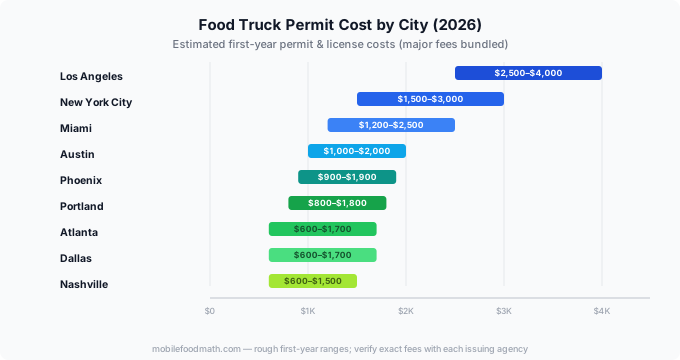
Permit costs are not one-size-fits-all. Dense, heavily regulated markets carry higher fees, longer wait times, and more application steps; smaller or truck-friendly cities are cheaper and faster. The figures below are rough first-year ranges that bundle the major permits together — they will not match your exact situation, so use them only to set expectations and verify locally.
Los Angeles, CA
Estimated first-year cost: $2,500 – $4,000. Health permit roughly $350–$800, mobile food permit $600–$1,400, plus fire inspection, business tax registration, and zoning approval. LA’s multi-step, multi-agency process adds both time and cost. See our Los Angeles food truck permits guide for the full step-by-step process.
New York City, NY
Estimated first-year cost: $1,500 – $3,000. NYC requires a mobile food vending license ($200–$1,500), a health department permit, commissary inspection, and a separate cart/truck permit. Capped license counts limit availability and push real-world costs higher. Carts follow a separate, cheaper licensing path — see our NYC food cart license cost guide.
Austin, TX
Estimated first-year cost: $1,000 – $2,000. One of the more streamlined markets: health permit $200–$500, mobile food unit permit $400–$800, fire inspection $75–$150. Austin’s online system shortens the timeline.
Portland, OR
Estimated first-year cost: $800 – $1,800. A relatively low barrier to entry — health permit $200–$600, vendor license $300–$700, fire inspection $100–$200 — and a deep food-cart culture that means more commissary options.
Miami, FL
Estimated first-year cost: $1,200 – $2,500. Miami-Dade County health permit $300–$700, city business license $100–$400, mobile vendor permit $400–$1,000. Seasonal demand drives competition for prime vending spots.
Atlanta, GA
Estimated first-year cost: $600 – $1,700. Atlanta operators navigate both city and Fulton County agencies for the health permit ($300–$700) and business license ($100–$400). A commissary agreement is required. See our Atlanta food truck permits guide for the step-by-step process.
Dallas, TX
Estimated first-year cost: $600 – $1,700. Texas keeps permitting relatively light: health permit $300–$600, mobile vendor permit $200–$500, business license $100–$300. City-specific vending zone rules apply for street operation. See our Dallas food truck permits guide for details.
Nashville, TN
Estimated first-year cost: $600 – $1,500. Nashville’s Metro Health Department issues the food service permit ($300–$600), and the Metro Codes office handles the business license ($100–$300). The event-heavy market means temporary event permits stack on top for festivals and fairs. See our Nashville food truck permits guide for the full process.
Phoenix, AZ
Estimated first-year cost: $900 – $1,900. Maricopa County Environmental Services issues the food handler permit ($400–$800); business license and city vending permit add $200–$400 more. Heat logistics matter: commissary access and refrigeration standards are enforced strictly in the summer. See our Phoenix food truck permits guide for details.
Even within a low-cost state, the local rules can add a wrinkle: Houston keeps Texas’s light-touch fees but requires every truck to affiliate with a licensed Central Preparation Facility, which our Houston food truck permits guide breaks down in full.
If you’re still deciding where to base your truck, the regulatory load should factor into the choice — see best city to start for how permitting difficulty compares with demand and cost of living.
The order to apply for permits
Permitting is just one phase of opening a truck; if you want to see where it slots into the whole launch — concept, business registration, vehicle, build-out, and first service — follow our overview on how to start a food truck and treat this page as the deep dive on the licensing step.
Sequencing matters because most permits depend on earlier ones being in hand. A rough order that works in most cities:
- Register your business and file your DBA. Form an LLC or sole proprietorship, get an EIN from the IRS, and register any trade name. This is step zero for everything that follows.
- Get your seller’s permit. Register with your state tax authority so you can legally collect sales tax. Usually free, and required before any food sales.
- Sign a commissary agreement. Most cities require a signed commissary agreement before you can even apply for a health permit.
- Apply for the health permit. Submit your menu, commissary agreement, and vehicle specs; the health department schedules an on-site truck inspection.
- Schedule the fire inspection. The fire marshal checks suppression, extinguishers, propane, and ventilation, then issues a certificate.
- Obtain the mobile food facility permit. The city’s core operating permit, issued once it sees your health permit, fire sign-off, insurance, and commissary agreement.
- Get food handler certifications. Every staffer who handles food completes a ServSafe or state-approved course.
- Apply for parking and vending permits. If you’ll street-vend, secure the zone or spot permits from the transportation or parks department.
Hidden and easy-to-miss permit costs
Beyond the headline fees, several costs surprise new operators. Re-inspection fees apply if you fail a health or fire check the first time. Plan-review or commissary-inspection fees can be charged before your truck is even on the road. Multi-city operation multiplies your business license and sometimes your health permit. Temporary event permits stack on top of your base permits for festivals. Insurance is usually required before the mobile food permit issues, so that premium is effectively a permit prerequisite. And renewals — most permits renew annually, with combined renewal costs often landing in the $500–$2,000 range. To roll all of this into one number alongside your truck and equipment, run the startup cost calculator, and read the full startup costs guide for the non-permit side of the budget.
Plan Your Full Startup Budget
Permits are just one piece of the puzzle. Use our free startup cost calculator to see the complete picture — vehicle, equipment, permits, and working capital all in one place.
Use the Startup Cost CalculatorFrequently asked questions
How much is a food truck permit in total?
Most operators spend roughly $1,000 to $5,000 in their first year across all permits and licenses. That typically includes a health permit ($100–$1,000), a business license ($50–$500), a mobile food facility permit ($100–$2,000), and a fire inspection ($50–$300), plus food handler certs and a commissary agreement. Annual renewals tend to run $500–$2,000. Your real number depends heavily on your city, so confirm each fee locally.
What permits are needed for a food truck?
At a minimum: a business license, a health/food handler permit, a mobile food facility permit, a seller’s permit for sales tax, food handler certifications for staff, and a fire inspection. Most cities also require a signed commissary agreement, a DBA if your trade name differs from your legal name, and proof of insurance before issuing the main permit. The exact list and naming vary by jurisdiction.
What is a mobile food facility permit?
It’s the core permit authorizing a vehicle to prepare and sell food, often called a mobile food vendor license or mobile food unit permit depending on the state. It usually sits last in the application chain because the issuing agency wants your health permit, fire inspection, commissary agreement, and insurance in place first. Costs commonly range from $100 to $2,000 or more per year.
Which city has the most expensive food truck permits?
New York City is among the priciest — its mobile food vending license runs $200–$1,500, and stacking the cart/truck permit and other requirements can push the annual total to $1,500–$3,000. Los Angeles and San Francisco also rank high, frequently exceeding $3,000 in combined first-year costs. Compare specifics on the permit cost by city page.
How long does it take to get food truck permits?
Usually 4 to 12 weeks, depending on your city and how quickly inspections can be scheduled. Streamlined markets with online applications, like Austin, can take 2–4 weeks, while New York City and Los Angeles often run 8–12 weeks or longer. Since several permits depend on earlier ones, delays compound — start early and line up your commissary agreement and inspections as soon as possible.
Methodology & Assumptions
Cost ranges are planning models assembled from the line items and assumptions shown in this guide. They are not quotes or guaranteed market averages. This page identifies 2 cited sources; official fees and requirements should be checked against those links. AI tools may assist with organization and drafting, but they are not a source and no independent food-truck operator review is claimed. Local rules and prices can change; verify them before committing funds. Last updated: 2026-09-06.
Sources & verification
- FDA — Food Code 2022 National model code; actual permits and fees are issued locally.
- U.S. Small Business Administration — Apply for licenses and permits Overview of how license requirements vary by activity and location.
Regulations and fees change. Confirm the current application, fee schedule, and operating rules with the issuing agency before purchasing a vehicle or signing a commissary agreement.