Food Truck Startup Costs: The Complete 2026 Budget
Starting a food truck is exciting — but the first question everyone asks is: how much does it actually cost to start a food truck? For 2026, most operators in the United States should plan for a total startup budget somewhere between $40,000 and $250,000, with the typical first-time used-truck owner landing around $85,000 to $120,000. The exact number depends on your vehicle choice, your menu, and how many costs you can avoid by buying used or starting small. This guide breaks down every line item, compares each setup type, and gives you hedged 2026 ranges so you can build a budget you can actually defend to a lender. To model your own concept in minutes, use our free food truck startup cost calculator.
How much does it cost to start a food truck in 2026?
There is no single answer, but there is a reliable framework. Your total food truck startup cost is the sum of six buckets: the vehicle, kitchen equipment and build-out, permits and licenses, initial inventory, insurance and deposits, and working capital to survive the first few months. Add them up and most concepts fall into one of three budget tiers — lean (under $50K), mid-range ($85K–$130K), or premium ($150K+).
Two operators selling the same tacos can have budgets that differ by $100,000 simply because one bought a 12-year-old step van and one ordered a new custom build. Before you fixate on a number, decide which trade-offs you are making: speed-to-revenue, vehicle lifespan, financing eligibility, and how much repair risk you can stomach. The sections below quantify each of those decisions.
Cost is only one stage of opening, of course. If you want the full launch sequence — from validating a concept and registering the business through permitting, build-out, and your first service — work alongside our complete guide on how to start a food truck, and use this page to put real numbers on each step it describes.
Food truck startup cost breakdown: line-item table
This is the most important table on the page. Every item below is a real cash outlay you should budget for before your first day of service. Ranges are hedged US 2026 estimates; your metro, menu, and build complexity will move you within (and occasionally beyond) these bands.
| Startup Line Item | Low | Typical | High |
|---|---|---|---|
| Vehicle (used step van or shell) | $15,000 | $55,000 | $90,000 |
| Kitchen equipment & build-out | $8,000 | $18,000 | $35,000 |
| Generator / power system | $1,500 | $4,500 | $10,000 |
| Permits & licenses | $500 | $2,500 | $6,000 |
| Initial inventory (food + paper) | $1,000 | $2,500 | $5,000 |
| Insurance (down payment / deposit) | $500 | $1,800 | $4,000 |
| Commissary kitchen deposit | $300 | $1,200 | $3,000 |
| POS system & hardware | $300 | $1,200 | $3,500 |
| Branding, wrap & signage | $1,500 | $5,000 | $12,000 |
| Working capital (2–3 months) | $8,000 | $15,000 | $25,000 |
| Estimated total | $37,100 | $106,400 | $197,500 |
A few notes on the line items most people underestimate. The vehicle wrap and branding routinely surprises owners — a full commercial wrap on a step van can run $3,000–$8,000 alone. The generator is non-negotiable for most cooking concepts and a quiet inverter unit can exceed $8,000. And working capital is the line most likely to sink a new truck: you need cash to cover rent, fuel, payroll, and re-stocking before revenue stabilizes. For a deeper itemized look at the build-out side, see the full equipment list, the dedicated guide to generator costs, and the dedicated guide to permit costs.
Used vs. new vs. trailer vs. cart: which is cheapest?
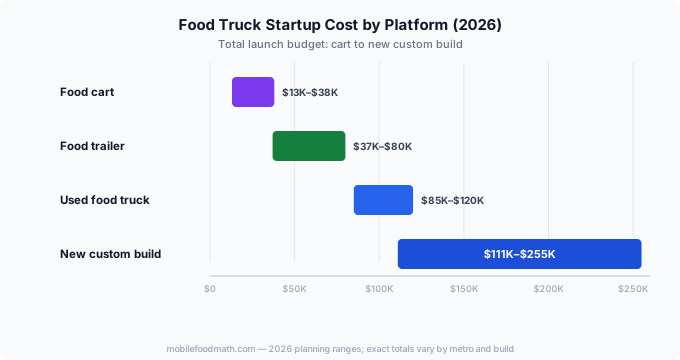
The single biggest lever on your budget is the platform you choose. A food cart and a new custom truck are different businesses with an order-of-magnitude cost gap. Use this comparison to match your capital, timeline, and menu ambitions.
| Platform | Startup Total (2026) | Time to Launch | Lifespan | Best For |
|---|---|---|---|---|
| Food cart | $13,000 – $38,000 | 2–6 weeks | 5–10 yrs | Hot dogs, snacks, single-item menus |
| Food trailer | $37,000 – $80,000 | 4–10 weeks | 10–15 yrs | Events, markets, leased lots |
| Used food truck | $85,000 – $120,000 | 3–8 weeks | 5–10 yrs | First-timers, full hot menus |
| New custom build | $111,000 – $255,000 | 3–6 months | 15–20 yrs | Funded operators, fleets, brands |
The cheapest full commercial kitchen on wheels is a food trailer, not a truck — you skip the cost of a self-powered chassis. The absolute cheapest entry point is a food cart, which can launch for under $20K but limits your menu and mobility. The used truck remains the default first-time choice because it balances a full kitchen with a fast launch. If you are weighing used inventory, our roundup of used trucks for sale covers what to inspect and what fair pricing looks like in 2026.
Total budget tiers: lean, mid-range, and premium
Most lenders and partners will ask which tier you are building toward. Here is how the three common budgets shake out once every cost is included.
| Budget Tier | Total Range | Typical Setup | Financing Reality |
|---|---|---|---|
| Lean / bootstrap | $13,000 – $50,000 | Cart or basic trailer, used gear | Self-funded or microloan |
| Mid-range | $50,000 – $130,000 | Used truck or new trailer, full kitchen | SBA, equipment loan, partial cash |
| Premium | $130,000 – $255,000+ | New custom build, premium wrap, redundancy | SBA 7(a), investor, or strong cash |
A lean budget gets you to revenue fastest and carries the least debt, but you will likely outgrow the equipment. The mid-range tier is where most sustainable single-truck businesses live. The premium tier only makes sense if you have committed catering contracts, a funded brand, or plans to scale into a fleet — the extra $100K buys reliability and resale value, not necessarily more daily revenue.
Used food truck: $85K – $120K
Many first-time owners choose a used vehicle to reduce the upfront cash requirement. In this planning model, a used step van or delivery truck converted for food service runs $50K–$80K, though clean low-mileage units in hot markets can push higher. Budget another $10K–$20K for cooking equipment, refrigeration, a generator, and a ventilation hood that satisfies your local code. These are editorial planning ranges rather than a measured national average, so compare multiple current vehicle and build-out quotes. For a deeper look at how the vehicle itself is priced — new shells, used conversions, and turnkey builds — see the full breakdown of how much a food truck costs.
The advantage is speed: you can be on the road in weeks, not months. The risk is mechanical. Trucks 10+ years old may need $5,000–$15,000 in repairs in your first year — transmission, generator, refrigeration compressors, and the propane or electrical system are the usual culprits. Always get a pre-purchase inspection from a diesel mechanic and budget a repair reserve inside your working capital. A used truck with a documented service history and a recent health inspection pass is worth paying a premium for.
New custom build: $111K – $255K
A new custom food truck is the premium option. You work with a builder who designs the layout, installs commercial equipment to spec, and handles health department compliance documentation. Expect 3–6 months from order to delivery, and budget for build-stage progress payments rather than one lump sum.
New builds last longer (15–20 years vs. 5–10 for a used unit), carry lower maintenance costs, and are far easier to finance because lenders treat them as depreciating-but-titled assets with clean paperwork. The downside is obvious: the upfront cost and wait time deter most first-timers, and you are paying for reliability you may not need if you are testing a concept. If you are unsure your menu has product-market fit, prove it on a used truck or trailer first, then commission a custom build once revenue justifies it.
Food trailer: $37K – $80K — the cheapest full kitchen
Food trailers are the most affordable way to get a full commercial kitchen on wheels. A trailer itself runs $20K–$50K, and equipment adds $8K–$15K. Total startup with working capital lands at $37K–$80K, roughly half the cost of a comparable used truck because you are not paying for a self-powered chassis.
The catch is logistics. You need a tow vehicle rated for the trailer’s loaded weight — add $5K–$15K if you don’t already own a suitable truck — and many cities restrict where trailers can park on public streets. Trailers shine at events, farmers markets, breweries, and leased private lots where you can set up and stay put. Check your target jurisdiction’s rules early; the permit costs and parking restrictions for trailers often differ from those for self-propelled trucks.
Coffee truck and cart: $51K – $120K
Coffee is one of the most profitable mobile food categories, with 60–80% gross margins on drinks. A full coffee truck runs $51K–$120K total, while a smaller coffee cart starts around $10K–$30K — ideal for farmers markets, office parks, and events. The defining equipment cost is the espresso machine ($5K–$15K for a commercial two-group unit) plus a quality grinder ($500–$2,000) and a water filtration system.
Coffee’s high margins mean a faster path to break-even than most hot-food concepts, but volume is everything — your fixed costs are high relative to the price of a single drink, so location and morning foot traffic decide your fate. Model the math before you commit.
Ice cream truck and cart: $59K – $116K
Ice cream and frozen dessert trucks carry lower food costs than hot-food concepts — ingredients run roughly 15–25% of revenue versus 30–35% for savory menus. A full ice cream truck costs $59K–$116K, while a cart starts near $10K–$25K, and a soft-serve truck with a commercial machine can reach $65K–$125K because the freezer/dispenser hardware is expensive.
The defining variable is seasonality: 60–70% of annual revenue often arrives in 4–5 summer months. Operators in warm-climate states (Florida, Arizona, Southern California, Texas) can extend to 8–10 active months, which dramatically improves the return on your equipment investment. Build your working-capital cushion to carry the slow season.
Food cart: $13.5K – $38K — the lowest entry cost
A food cart — hot dog cart, smoothie cart, churros, or prepackaged snacks — is the cheapest way to start a mobile food business. A basic cart runs $5K–$20K, equipment adds $3K–$8K, and total startup lands at $13.5K–$38K. Carts are limited in menu and daily volume, but they offer the fastest, lowest-risk path to revenue and are the standard proving ground for a single-item concept before scaling up. The full economics live in our food cart startup cost guide.
Permits, licenses, and the costs first-timers forget
The sticker price of the vehicle is only the beginning. Permits and licenses vary wildly by jurisdiction — a business license, health department permit, mobile food vendor permit, fire inspection, and seller’s permit can collectively run $500 in a light-touch county to $6,000+ in a strict city like Boston, San Francisco, or New York. Some cities also require a commissary affiliation before they will issue a permit at all.
Your total startup budget shifts with the city the same way, not just the permit line. The trade-friendly markets tend to run leanest, while California and the coastal hubs run high. We break the numbers down city by city in dedicated guides for Austin, Chicago, Denver, Miami, Portland, San Diego, San Francisco, and Seattle — worth checking the one closest to where you plan to launch.
Then there are the recurring “hidden” costs that erode margin every month:
| Recurring Item | Typical 2026 Cost |
|---|---|
| Commissary kitchen rental | $300 – $800/mo |
| Insurance (liability + vehicle) | $200 – $600/mo |
| Permit & license renewals | $200 – $1,000/yr |
| Fuel & generator propane | $300 – $800/mo |
| POS & credit card processing | $100 – $300/mo |
| Marketing & social | $200 – $500/mo |
Insurance alone deserves its own analysis — general liability, commercial auto, and workers’ comp stack quickly. See the dedicated insurance costs guide before you quote a final budget to a lender.
How much working capital do you really need?
Working capital is the cash that keeps you alive between launch and consistent profitability. The common mistake is spending the entire budget on the truck and equipment, then running out of money in month two when sales are still ramping. Plan for 2–3 months of full operating expenses, which for most single-truck businesses means $8,000–$25,000 set aside and untouched at launch.
A safe rule: total your monthly fixed costs (commissary, insurance, loan payment, fuel, payroll, marketing), multiply by three, and treat that as a non-negotiable reserve. If your budget can’t cover the truck and the reserve, scale down the platform — a trailer or cart with a healthy cushion beats a leveraged truck with no runway.
How to lower your food truck startup cost
You have more control over the total than you think. Buying a used truck instead of a new build can save $50,000–$130,000 outright. Sourcing used commercial equipment from restaurant auctions or closures can cut the kitchen build by 30–50%. Starting as a trailer or cart and reinvesting profits into a truck later spreads the capital over time and de-risks the concept. Leasing a commissary by the hour rather than by the month lowers fixed cost while you find your volume. And a partial vinyl wrap or magnetic signage instead of a full wrap can save several thousand dollars in year one.
Be careful where you cut, though. Skimping on the ventilation hood, refrigeration, or generator usually backfires — these are the systems whose failure shuts down service and trigger emergency repair premiums.
Estimate your exact number
Calculate Your Exact Startup Costs
Our free calculator compares 6 business models side by side — see your estimated total with vehicle, equipment, permits, and working capital all included.
Use the Startup Cost CalculatorOnce you have a startup number, the next question is when you’ll earn it back. Run your fixed costs, food cost percentage, and average ticket through the break-even calculator to see how many service days it takes to recover your investment — and walk through the full method in our break-even analysis guide to check whether your chosen platform and menu actually pencil out before you sign anything.
Frequently asked questions
How much does it cost to start a food truck in 2026?
Most food trucks cost between $50,000 and $200,000 to launch in 2026. A used truck typically runs $85K–$120K all-in, a new custom build $111K–$255K, and a food trailer $37K–$80K. The number swings with your vehicle choice, menu, and local permit costs.
What is the cheapest way to start a food truck business?
A food cart is the cheapest path at $13,500–$38,000, and a prepackaged snack or ice cream cart can start as low as $10K–$15K. Among full-kitchen options, a food trailer at $37K–$80K is roughly half the cost of a used truck because it has no self-powered chassis.
How much working capital do I need for a food truck?
Plan for 2–3 months of operating expenses, typically $8,000–$25,000, kept in reserve at launch. Budget the truck and the cushion together — running out of cash in month two is one of the most common reasons new trucks fail.
Should I buy a new or used food truck?
About 80–85% of first-time owners buy used to launch faster and carry less debt. New custom builds cost $111K–$255K and take 3–6 months but last 15–20 years and finance more easily. A common path is to start used, prove the concept, then commission a custom build once revenue justifies it.
Food trailer vs. food truck: which is cheaper?
A food trailer costs $37K–$80K total — roughly half the cost of a comparable used truck — because you skip the self-powered chassis. The trade-off is that you need a tow vehicle and many cities restrict where trailers can park on public streets.
Methodology & Assumptions
Cost ranges are planning models assembled from the line items and assumptions shown in this guide. They are not quotes or guaranteed market averages. This page identifies 2 cited sources; official fees and requirements should be checked against those links. AI tools may assist with organization and drafting, but they are not a source and no independent food-truck operator review is claimed. Local rules and prices can change; verify them before committing funds. Last updated: 2026-09-06.
Sources & verification
- U.S. Small Business Administration — Calculate your startup costs Framework for separating one-time expenses, assets, and ongoing operating costs.
- FDA — Food Code 2022 Federal model code used by many jurisdictions for retail food-safety requirements.
Regulations and fees change. Confirm the current application, fee schedule, and operating rules with the issuing agency before purchasing a vehicle or signing a commissary agreement.